ViviLux 3-in-1 Red Laser GuideBest overall
- Beams
- Line, crosshair and dot
- Power
- Rechargeable, cordless
- Battery
- 20+ hours per charge (maker's rating)
Most recommended by reviewers
Check price at AmazonIf you buy through our links we may earn a commission. That never decides which products we recommend.
We earn a commission when you buy through our links, at no extra cost to you. How this works.
A laser light clips onto your sewing machine and throws a thin red line onto your fabric. It helps you keep your seams straight, even when you are new to sewing or working on a tricky project. Here is what's available right now.
Our top pick is the ViviLux 3-in-1 Red Laser Guide. It offers a clear, bright line and works with a range of machines. For a magnetic option, the IKKAB 5mW Magnetic Laser Seam Guide is also a good choice, and the CKPSMS Laser Light Guide with AC Plug is another solid pick.
1 ViviLux 3-in-1 Red Laser Guide | 2 IKKAB 5mW Magnetic Laser Seam Guide | 3 CKPSMS Laser Light Guide with AC Plug | |
|---|---|---|---|
| Best for | Best overall | Best budget | Best plug-in |
| Beam | Line, crosshair and dot | Crosshair | Crosshair |
| Power | Rechargeable, cordless | USB | AC plug, 51 in (1.3 m) cord |
| Mount | Not listed | Magnet, plus adhesive metal discs | Magnetic base |
| Check price at Amazon | Check price at Amazon | Check price at Amazon |
ViviLux 3-in-1 Red Laser GuideBest overallMost recommended by reviewers
Check price at Amazon IKKAB 5mW Magnetic Laser Seam GuideBest budget
 CKPSMS Laser Light Guide with AC PlugBest plug-in


The one established brand in a category full of look-alikes: three interchangeable beam heads, and a rechargeable battery so no cable crosses your sewing bed.
Most recommended by reviewers
Check price at AmazonPrices and availability on Amazon change often.
One catchIt costs several times more than the generic magnetic lights.
A laser guide does one job: put a crisp line on the fabric exactly where your seam should run. Every light on this page does that. What sets the ViviLux apart is everything around the beam. Swapping heads means one light handles a straight seam allowance, a crosshair for hitting corners and zipper ends, and a single dot for marking start and stop points when you quilt.
The battery matters more than it sounds. Plug-in and USB lights put a cable right where your hands and fabric move, and on a long quilt that cable is a constant snag. A cordless light avoids that entirely.
It costs several times more than the generic magnetic lights. If you only sew the occasional straight seam, our budget pick does the core job for far less.
Quilters and frequent sewists who want one light for every kind of guide line, and anyone who hates cables near the needle.


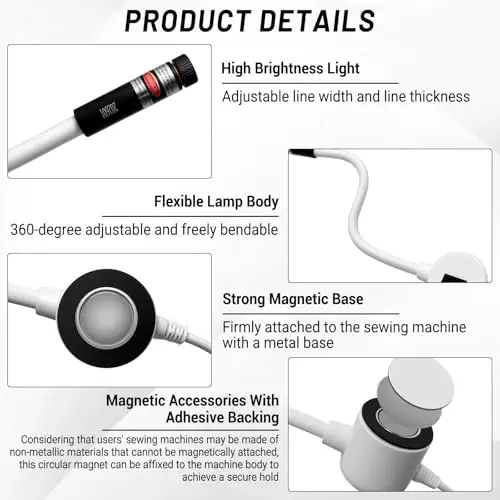


The generic magnetic crosshair light, in the version that clearly states its laser class and includes mounts for plastic machine bodies.
Prices and availability on Amazon change often.
The same magnetic crosshair light appears on Amazon under well over a dozen brand names, with near-identical photos and features. Since the hardware is effectively the same, we chose the listing on two things a buyer can actually check: whether it states its laser class, and whether it includes a way to mount on a non-metal machine. This one does both.
Anyone trying a laser guide for the first time, or sewing straight seams a few times a month.


A plug-in light that never dims halfway through a project, with the longest gooseneck and cord of our picks.
Prices and availability on Amazon change often.
Battery and USB lights are convenient, but a plug-in light is the one you can leave mounted and forget. The 7-inch gooseneck is long enough to clear bigger machine heads and still aim the beam just in front of the needle.
Sewists with a permanent setup who sew for hours at a time.
Four things actually differ between these lights. Decide on these, and the brand barely matters.
| Choice | Options | Pick it if |
|---|---|---|
| Beam shape | Line | You mostly sew straight seams and want to follow a seam allowance. |
| Crosshair | You need the exact needle point: corners, zipper ends, buttonholes. | |
| Dot | You quilt dot-to-dot or mark start and stop points. | |
| Power | Rechargeable | You want no cable near the needle. |
| USB | You want the cheapest option and have a spare USB port or charger. | |
| AC plug | You sew for hours at a fixed setup. | |
| Beam color | Red | You want the cheapest option. Red is fine in moderate light. |
| Green | Your sewing room is bright, or you find red hard to see. | |
| Mount | Magnet | Your machine has a metal surface to attach to. |
| Adhesive metal disc | Your machine's housing is plastic. | |
| Laser class | Stated on the listing | Always. Skip listings that don't say. |
Treat a sewing laser like a laser pointer. Most are Class IIIa, also written 3R, at up to 5mW. That class can be momentarily hazardous if you look straight into the beam, and more so through a magnifier.
Laser lines are easiest to see in moderate light and on flat fabric. Under bright overhead light a red beam fades, and wrinkles break the line, so press your fabric first. A green beam stays visible in brighter rooms.
Mount it so the beam points just in front of the needle, line the beam up with the needle point or your seam allowance on a scrap, then sew so the fabric edge or marked line tracks the beam. Re-check the alignment whenever you change presser feet.
A line is best for straight seams and keeping a consistent seam allowance. A crosshair shows the exact needle point, which helps with corners and zippers. A dot is for dot-to-dot quilting and marking start and stop points. A 3-in-1 light with swappable heads, like the ViviLux, covers all three.
Universal laser guides aren't brand-specific. A magnetic base attaches to any metal surface, and most of these lights include adhesive metal discs for plastic housings. Check that there's a spot on the head or arm where the beam can point down in front of the needle.
Yes, used sensibly. Most are Class IIIa (3R) lasers of up to 5mW, the same class as many laser pointers. They can be momentarily hazardous if you look directly into the beam, so aim them at the fabric, switch them off before looking under the presser foot, and keep them away from children.
Rechargeable is the most convenient because there's no cable near the needle. USB lights are the cheapest. A plug-in light gives steady brightness for long sessions at a fixed setup.
Green is easier to see, especially in a bright room, on busy prints and for people who struggle to pick out red. Red lasers cost less and work well in moderate light. If you sew under strong overhead lights, the extra cost of green is worth it.
Bright overhead lighting washes out a red beam, and wrinkled fabric breaks up the line. Dim the light a little, press your fabric, and aim the beam at a low angle close to the needle. If it's still hard to see, a green laser is noticeably easier to pick out on most fabrics.
Yes. A dot or crosshair gives you a fixed reference point for where the needle will land, which helps you start and stop lines precisely. For straight-line quilting, a line beam also helps you space rows evenly: sew one row, then line the beam up with it before sewing the next.
Why trust BullseyeBuy
Most laser guides on Amazon are the same few designs sold under dozens of brand names. We sorted the listings into what is actually different, checked each one's laser class and power source, and watched sewists and quilters set these lights up and use them on camera. Every source we used is listed at the bottom of the page.
Our expert team tests products when it is needed and researches online and in interviews. Every guide is fact-checked and edited by a real person.
The BullseyeBuy editorial team · Updated Oct 13, 2026
How we pickEditorial standardsAffiliate disclosureReport a mistake
We earn a commission when you buy through our links, at no extra cost to you. It never decides the winner.